


US Avionics Market: Industry Trends, Digital Cockpit Adoption & Outlook
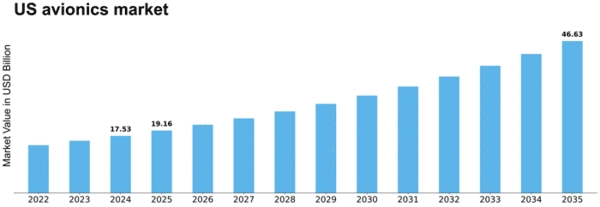
As per Market Research Future analysis, the US avionics market Size was estimated at 17.53 USD Billion in 2024. The US avionics market is projected to grow from 19.16 USD Billion in 2025 to 46.63 USD Billion by 2035, exhibiting a compound annual growth rate (CAGR) of 9% during the forecast period 2025 - 2035.
Introduction
The US avionics market plays a critical role in shaping the nation’s aviation ecosystem, supporting commercial airlines, general aviation, military aircraft, and emerging air mobility platforms. Avionics systems form the digital backbone of modern aircraft, enabling navigation, communication, surveillance, flight control, and real-time data processing. As aviation operations grow increasingly complex, the need for advanced, reliable, and integrated avionics solutions continues to rise.
With the United States being home to one of the largest aviation fleets globally, demand for avionics is driven by both new aircraft production and extensive retrofit programs. The market is also influenced by strict safety regulations, technological innovation, and growing defense investments. These factors collectively position the US avionics market for sustained long-term growth.
Market Growth and Trends
Market growth in the US avionics sector is being fueled by rising passenger air traffic, airline fleet modernization programs, and technological upgrades aimed at improving efficiency and safety. Commercial aviation remains a dominant contributor, as airlines increasingly adopt glass cockpits, advanced flight management systems, and satellite-based navigation technologies.
Another notable trend is the rapid adoption of integrated avionics suites, which consolidate multiple aircraft functions into centralized digital platforms. This shift reduces pilot workload, improves situational awareness, and enhances operational reliability. Additionally, the defense aviation segment continues to invest heavily in advanced avionics for fighter jets, transport aircraft, and surveillance platforms.
Key trends shaping the market include the transition toward software-defined avionics, greater use of data analytics, and increased focus on real-time connectivity between aircraft and ground systems. These trends reflect the industry’s move toward more intelligent and connected aviation operations.
Key Drivers, Challenges, Trends, Opportunities
Key Drivers
-
Fleet Modernization Initiatives: Airlines and defense operators are upgrading aging aircraft with modern avionics to meet regulatory and performance requirements.
-
Air Traffic Management Upgrades: Implementation of advanced navigation and surveillance systems supports safer and more efficient airspace operations.
-
Defense Spending: Continuous investment in military aircraft modernization significantly drives avionics demand.
Challenges
-
Integration Complexity: Integrating new avionics with legacy aircraft systems can be technically challenging and time-consuming.
-
High Development Costs: Advanced avionics systems require significant R&D investments, impacting profitability for smaller players.
-
Certification and Compliance: Meeting stringent FAA certification requirements can delay product launches.
Trends
-
Connected Aircraft Systems: Increased use of real-time data exchange enhances flight monitoring and predictive maintenance.
-
Automation and AI Integration: Automated flight assistance systems are becoming more prevalent in both commercial and military aviation.
-
Miniaturization of Components: Compact and lightweight avionics improve fuel efficiency and aircraft performance.
Opportunities
-
Retrofit and Upgrade Market: Existing aircraft upgrades represent a substantial revenue opportunity.
-
Next-Generation Aircraft Programs: New aircraft designs require advanced avionics architectures.
-
Cyber-Resilient Avionics Solutions: Growing digitalization creates demand for secure avionics platforms.
Future Scope
The future scope of the US avionics market is highly promising, supported by continuous innovation and expanding aviation applications. By 2035, the market is expected to benefit from advancements in autonomous flight technologies, enhanced human-machine interfaces, and expanded use of artificial intelligence.
Emerging areas such as electric aircraft, urban air mobility, and unmanned systems will further broaden avionics applications. Companies that focus on flexible, scalable, and cybersecure avionics solutions are likely to gain a competitive advantage. Overall, the US avionics market is set to remain a cornerstone of global aviation technology development.
Discover More Research Reports on Aerospace & Defense By Market Research Future:
china integrated bridge system for ships market
germany integrated bridge system for ships market

 English
 Arabic
 Spanish
 Portuguese
 Deutsch
 Turkish
 Dutch
Dutch
 Italiano
 Russian
 Romaian
 Portuguese (Brazil)
 Greek
Greek