


Worldwide UAV Payload Subsystems Market: Defense and Commercial Demand Forecast
Operational efficiency is a critical metric for UAV deployment across defense and commercial sectors. Payload innovation plays a decisive role in improving efficiency by enhancing data quality, reducing mission time, and minimizing operational costs. The UAV payload subsystems market is therefore closely linked to efficiency-driven adoption.
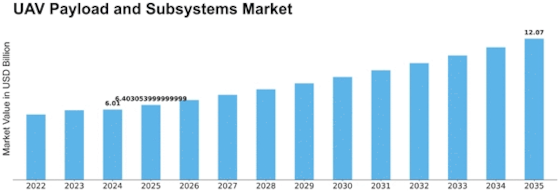
According to Market Research Future, the UAV Payload Subsystems Market was valued at approximately USD 6.01 billion in 2024. It is projected to grow from USD 6.403 billion in 2025 to USD 12.07 billion by 2035, with a compound annual growth rate (CAGR) of 6.54% during the forecast period from 2025 to 2035.
Advanced payload subsystems enable UAVs to accomplish more within a single flight. High-resolution sensors, combined with intelligent data processing, reduce the need for repeated sorties. For example, a single UAV equipped with multiple sensor payloads can perform visual inspection, thermal analysis, and mapping simultaneously.
Real-time data processing is a major efficiency enhancer. Payload subsystems that analyze data onboard reduce reliance on ground-based processing and allow operators to make immediate decisions. This capability is especially valuable in emergency response, security operations, and time-critical inspections.
Payload reliability also influences efficiency. Robust payload subsystems minimize mission disruptions caused by sensor failure or data loss. Improved stabilization, environmental protection, and redundancy ensure consistent performance across diverse operating conditions.
Energy-efficient payload design further contributes to operational efficiency. Lightweight materials, low-power electronics, and adaptive operating modes help extend flight duration. Longer endurance translates into wider coverage, fewer launches, and lower operational costs.
In commercial operations, efficient payload subsystems support scalable deployment. Standardized payload interfaces and automated calibration reduce setup time and training requirements. This makes UAV operations more accessible to organizations with limited technical resources.
However, achieving efficiency through payload innovation requires careful system-level optimization. Payload capabilities must align with UAV platform limits and mission requirements. Overloading a UAV with excessive payload functionality can reduce endurance and negate efficiency gains.
The growing emphasis on efficiency is shaping payload development priorities. Manufacturers are focusing on integrated, intelligent payload solutions that deliver maximum value per flight. As UAV operations scale globally, payload efficiency will remain a key competitive differentiator.
Discover More Research Reports on Aerospace & Defense By Market Research Future:

 English
 Arabic
 Spanish
 Portuguese
 Deutsch
 Turkish
 Dutch
Dutch
 Italiano
 Russian
 Romaian
 Portuguese (Brazil)
 Greek
Greek